Imagine two objects side by side.
One is an ancient clay pot, its surface pressed with the marks of twisted cord.
The other is a page of flowing handwriting, written with a brush.
They seem to belong to different worlds. The pot makes us think of food, fire and the work of shaping a container by hand. The handwriting makes us think of words, paper and someone taking care over how a message would be received.
Between these two objects lies much of the early cultural history of Japan. Not all of it, but enough to begin.
So instead of asking what "the Japanese spirit" has always been, let's ask some simpler questions.
Who made this?
What was it for?
And what made its shape possible?
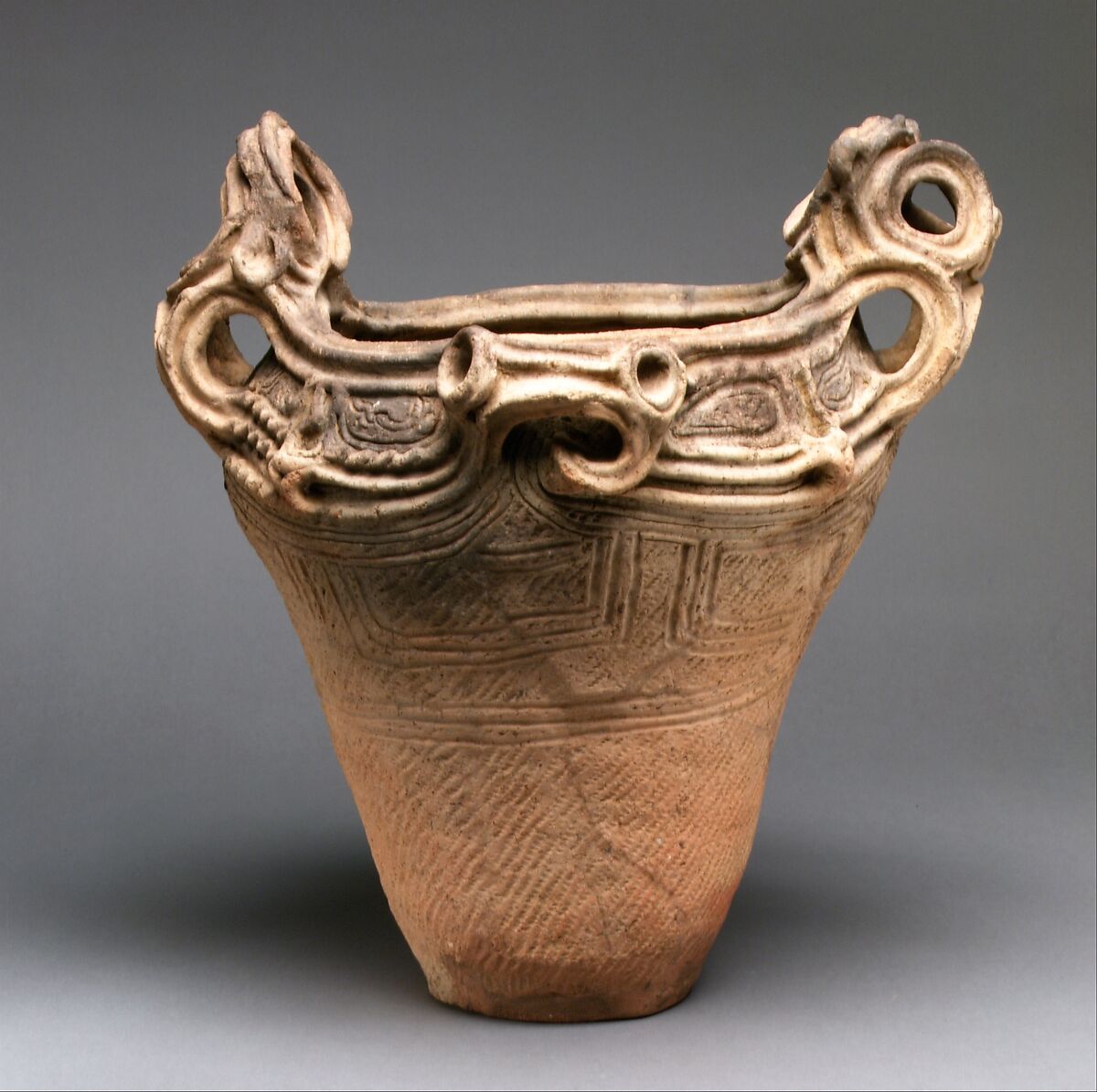

Before the court: start with a vessel
Jōmon (縄文) pottery comes from a very long prehistoric age. The Jōmon period lasted for more than ten thousand years, and life was not the same in every place or in every century.3 The name itself comes from the cord patterns pressed into the clay.4
So one spectacular pot in a museum should not stand for every pot, or for every household.
People lived mainly by hunting, gathering and fishing. Their pottery reminds us that a simple container could have a cultural history long before there were palaces or written records.4
Studies of human remains from this long period have also found very few signs of violent death. This has led researchers to suggest that warfare was probably not common in Jōmon Japan. This does not mean that conflict never occurred, or that every community was peaceful.3
The Jōmon period does not fit the familiar stereotype of prehistory as an age of crude survival and constant violence. Over its many millennia, people developed pottery, ornaments and other forms of skilled making. In some regions, communities also established long-lasting settlements.45
One of the most striking later forms is the flame-style vessel (kaen-gata doki), especially associated with the Middle Jōmon of what is now Niigata. Its dramatic rim shows how inventive and visually powerful Jōmon pottery could become.6

Later periods brought different emphases. In the Yayoi period, wet-rice agriculture, metal tools and new continental influences reshaped daily life. These changes began in different regions at different times.8
In the Kofun period, large burial mounds and emerging political centers point to a more stratified society and the early formation of state power. The sequence was not uniform across the archipelago.9
In the fifth century, the techniques for making Sue ware (須恵器, sueki), a hard, high-fired pottery, came to Japan from the Korean peninsula.10
What arrived was more than a finished object. People learned new ways to build kilns and control the fire. Later, in the Asuka and Nara periods, potters in Japan also began making colorful green-glazed and three-color wares, inspired by lead-glazed pottery from China and the Korean peninsula.10

So when you look at an early vessel, start with its body and its surface. Is it soft earthenware or a harder, high-fired ware? Was the color painted on, or did it come from a glaze and the conditions inside the kiln?
Questions like these make cultural exchange visible. They also stop us from treating all old Japanese ceramics as if they shared one taste for "rustic simplicity".
A religion arrived with people and things
Buddhism (仏教, bukkyō) reached Japan through networks that linked South Asia, China and the Korean peninsula. One key moment in the written record is its formal introduction by King Seong (聖明王) of Baekje (百済, Kudara), in either 538 or 552.11 Images, texts and ritual knowledge traveled together with the people who could read, explain and use them.
This was not easy.
A statue could be carried across the sea. But a living religious institution needed teachers, translators, patrons and trained specialists.

The Chinese monk Ganjin (鑑真) shows how much effort this could take. He failed five times to cross the sea and lost his sight along the way. On his sixth attempt, in 753, he finally reached Japan.12
That is the distance between carrying an object and carrying a tradition.
Buddhism became part of the life of the court and its temples. But it did not stay apart from the worship already there.
Today we often draw a neat line between a Buddhist temple (寺, tera) and a Shinto shrine (神社, jinja). That line can hide centuries in which the two were closely connected.
From the Heian period onward, for example, people made votive mirrors that brought the two together. The mirror itself stood for a kami (神), a deity of local worship, and an image of a Buddhist deity was engraved on it or attached to it. Kami and buddhas were often understood as part of one connected religious world.13

So when you visit a temple or a shrine, it is worth asking about the history of that particular place, rather than assuming two completely separate traditions.
The same caution applies to tea. When did people in Japan begin drinking it? The Kyoto National Museum points to one early answer: a record from the early Heian period of the monk Eichū (永忠) serving tea to Emperor Saga (嵯峨天皇).15
That tells us about one particular moment; it does not show that people all over Japan were drinking tea every day. The later stories of whisked tea (抹茶, matcha) and sencha (煎茶) each need their own explanation.
What changed at the Heian court
In 794, the capital moved to Heian-kyō (平安京), the city we now know as Kyoto (京都, Kyōto). This move is usually taken as the beginning of the Heian period.1617
The famous court culture of this period was built on earlier exchanges with the continent. Chinese writing, learning and Buddhist traditions remained important.16

Writing shows this especially clearly.
Chinese characters (漢字, kanji) could be used for learned texts. But they could also be adapted to write the Japanese language. Kana (仮名), phonetic scripts developed from Chinese characters, then let writers set down Japanese more directly.19
The graceful brushwork we connect with the Heian court grew out of a writing technology that came from China and was reshaped as people in Japan used it.19
These two Heian-period manuscripts show different ways writing was used. One preserves a Chinese text written in characters; the other records Japanese poetry in flowing kana. Both belonged to the cultural world of the court.

Qunshu Zhiyao (detail), copied by unidentified scribes in 11th-century Japan. Tokyo National Museum, National Treasure. Image: ColBase (cropped).20 View complete artwork.

Karasumaru Fragment (detail), early 12th century. Traditionally attributed to Fujiwara no Sadayori. The Metropolitan Museum of Art. Public Domain (CC0).21 View complete artwork.
Making something Japanese did not mean letting go of what had come from outside.
Women at court were central to the literature that lets us see this world today. Murasaki Shikibu (紫式部) wrote The Tale of Genji (源氏物語, Genji monogatari).22 Sei Shōnagon (清少納言) wrote The Pillow Book (枕草子, Makura no sōshi), which we explore in The Pillow Book: A Thousand Years of Noticing Small Things. Each opens a different window onto the relationships and observations of court life.
Hiragana (平仮名), the flowing form of kana, was called the "women's hand" (女手, onnade) because women were its main users.23 Writing in Japanese, rather than in Chinese, was strongly linked with women at court.24
But the label has limits. Murasaki Shikibu herself had learned Chinese, which was then regarded as men's learning.24
The courtier Ki no Tsurayuki (紀貫之) wrote The Tosa Diary (土佐日記, Tosa nikki) in kana, rather than in the Chinese that was normal for men's diaries.25 The Heian texts that survive belong to several writing traditions.26
Think back to that page of handwriting. In this world, a message was not just information. It was a social act, and it would be judged.
The choice of words and the way a message was presented mattered, because they helped people manage their relationships in a very demanding social world. Refinement was a skill with real consequences. It could bring someone into a circle, impress a patron or reveal a lapse in judgment.
When you read the literature with this in mind, its delicate details feel much less distant.
Yet the court was only a small, privileged part of society. Its literature does not show us how most households lived; the evidence that survives simply lets us see the court far more clearly than the countryside.
Reading the period through things today
If you decide to start The Tale of Genji, choose an edition with notes on relationships, ranks and religious references. Treat the notes as a way into the scene, not as something to study for an exam. A character's reaction to an object or a season often makes much more sense once you know what was at stake between the people involved.
In a museum, try comparing an imported piece with a version made in Japan. Look for a changed shape, a different material or a new purpose.
"Japanese" does not have to mean untouched by outside influence.
It can describe the particular history through which people in Japan made something their own.
The same way of looking can help when you buy something made today. A maker's explanation of the clay, the firing, the paper or the technique will tell you much more than a general promise of "timeless tradition".
Early Japanese culture does not give us one antique style to copy. It gives us questions to ask.
So try this with one ordinary object in your own life: a cup, a letter or a bowl. Hold two histories in mind at once.
What materials and skills made it possible?
What meaning has it gathered through being used?
Like the cord-marked pot and the page of brushwork, it will have more to tell you than "beautiful".
Sources
[01] The Metropolitan Museum of Art, Deep Pot (Fuka-bachi), 1992.252.1
[02] The Metropolitan Museum of Art, Four Poems from the Sekido Version of the Kokin wakashū, 2020.88
[03] Nakao, H. et al. (2016), Violence in the prehistoric period of Japan: the spatio-temporal pattern of skeletal evidence for violence in the Jomon period, Biology Letters 12; see also the authors’ 2016 correction.
[04] Sainsbury Institute, Project Jōmon
[05] UNESCO World Heritage Centre, Jomon Prehistoric Sites in Northern Japan
[08] The Metropolitan Museum of Art, Yayoi Culture
[09] The Metropolitan Museum of Art, Kofun Period
[10] Museum of Oriental Ceramics, Osaka, Brief History of Japanese Ceramics
[11] ColBase, Buddha with Two Attendants (Tokyo National Museum, N-143)
[12] Kyoto National Museum, Ganjin and Buddhist precepts exhibition
[13] Kyoto National Museum, Divine Reflections: Medieval Votive Mirrors
[14] The Metropolitan Museum of Art, Votive Mirror with Eleven-Headed Kannon, 1975.268.157
[15] Kyoto National Museum, Tenmoku and early tea records
[16] Columbia University, Heian Japan
[17] Agency for Cultural Affairs / Japan Cultural Expo, Heian timeline (This timeline starts the Heian period with the move to Nagaoka-kyō in 784; 794 is the more common starting date.)
[19] Metropolitan Museum of Art, Brush Writing
[20] Tokyo National Museum / ColBase, Qunshu Zhiyao (Gunsho chiyo), volume 22, B-2531, National Treasure; copied by unidentified scribes, 11th century; ColBase Terms of Use (CC BY 4.0 compatible)
[22] Metropolitan Museum of Art, Tale of Genji exhibition galleries
[23] Digital Daijisen (Shogakukan), 女手 (onnade), via Kotobank
[24] Encyclopaedia Britannica, Murasaki Shikibu
[25] Encyclopaedia Britannica, Ki no Tsurayuki
[26] NINJAL, Corpus of Historical Japanese: Heian Period Series
10 Quiet Ways to Bring a Little Japan into Your Everyday Life
Ten quiet invitations to bring Japanese ways of seeing into everyday life.