The calendar says spring has begun. But the pavement is icy, and you still need your warmest coat.
Has something gone wrong?
Not really. Risshun (立春), "the beginning of spring", is one of the 24 sekki (二十四節気, nijūshi sekki), a traditional way of dividing the solar year. It does not promise that the weather outside your door has turned springlike.
Once you see what the calendar is actually marking, that icy morning stops looking like a mistake, and the names become something you can use.

What the 24 sekki actually divide
The 24 sekki follow the sun's apparent path through the year. A new term begins each time the sun moves another fifteen degrees along that path. Shunbun (春分), the spring equinox, sits at 0 degrees, and Shūbun (秋分), the autumn equinox, at 180 degrees.2
Strictly speaking, each term marks a moment. But the same name also covers the period of roughly fifteen days that starts at that moment.23
Those periods are not all exactly the same length. Some are a little under fifteen days, others closer to sixteen.45
Because the system follows the sun, each term falls on almost the same date every year in today's calendar.3
- Spring equinox
- Shunbun · 0°
- Summer solstice
- Geshi · 90°
- Autumn equinox
- Shūbun · 180°
- Winter solstice
- Tōji · 270°
- Spring begins
- Risshun · 315°
Why the four "beginnings" can feel surprising
So why does "spring begins" arrive in the middle of winter?
In the traditional scheme, Risshun comes straight after the two terms named for the coldest part of the year: Shōkan (小寒), "lesser cold", and Daikan (大寒), "greater cold". Risshū (立秋), "autumn begins", comes straight after the two named for the hottest part of the year: Shōsho (小暑) and Taisho (大暑).3
These are traditional seasonal divisions, not a promise that the coldest or hottest weather has already passed where you live. Cold or hot days can continue well beyond them.3
You can still see this in Japanese letter-writing today. From these days on, seasonal greeting cards take a different name:3
- After Risshun: a "midwinter greeting" (寒中見舞い, kanchū mimai) becomes a "lingering cold greeting" (余寒見舞い, yokan mimai).
- After Risshū: a "midsummer greeting" (暑中見舞い, shochū mimai) becomes a "lingering heat greeting" (残暑見舞い, zansho mimai).
Today, yokan mimai is less commonly used than the other three greetings.
Japan itself has a wide range of climates. On the same day, people in different regions may be living with snow, rain or warm air. No single town's weather has to stand for the whole country.
Wherever you live, there are still more variables: latitude, altitude, distance from the coast, the extra warmth of a city. Follow the names with curiosity, but let what you actually see have the final word.
The twenty-four terms at a glance
Here are all twenty-four terms, with their dates for 2026 and 2027 in Japan Standard Time. The list starts in January for easy reference, though the traditional cycle begins with Risshun in early February.45
| Term | Meaning | 2026 | 2027 |
|---|---|---|---|
| 小寒 Shōkan | Lesser cold | 5 Jan | 5 Jan |
| 大寒 Daikan | Greater cold | 20 Jan | 20 Jan |
| 立春 Risshun | Spring begins | 4 Feb | 4 Feb |
| 雨水 Usui | Rainwater | 19 Feb | 19 Feb |
| 啓蟄 Keichitsu | Insects stir | 5 Mar | 6 Mar |
| 春分 Shunbun | Spring equinox | 20 Mar | 21 Mar |
| 清明 Seimei | Clear brightness | 5 Apr | 5 Apr |
| 穀雨 Kokuu | Grain rain | 20 Apr | 20 Apr |
| 立夏 Rikka | Summer begins | 5 May | 6 May |
| 小満 Shōman | Lesser fullness | 21 May | 21 May |
| 芒種 Bōshu | Grain sowing | 6 Jun | 6 Jun |
| 夏至 Geshi | Summer solstice | 21 Jun | 21 Jun |
| 小暑 Shōsho | Lesser heat | 7 Jul | 7 Jul |
| 大暑 Taisho | Greater heat | 23 Jul | 23 Jul |
| 立秋 Risshū | Autumn begins | 7 Aug | 8 Aug |
| 処暑 Shosho | Heat subsides | 23 Aug | 23 Aug |
| 白露 Hakuro | White dew | 7 Sep | 8 Sep |
| 秋分 Shūbun | Autumn equinox | 23 Sep | 23 Sep |
| 寒露 Kanro | Cold dew | 8 Oct | 8 Oct |
| 霜降 Sōkō | Frost descends | 23 Oct | 24 Oct |
| 立冬 Rittō | Winter begins | 7 Nov | 8 Nov |
| 小雪 Shōsetsu | Lesser snow | 22 Nov | 22 Nov |
| 大雪 Taisetsu | Greater snow | 7 Dec | 7 Dec |
| 冬至 Tōji | Winter solstice | 22 Dec | 22 Dec |
Dates: National Astronomical Observatory of Japan, in Japan Standard Time45. Names checked against2.
A few notes on using it:
- The English is a label, not a full translation. "Lesser fullness" is a short way of rendering Shōman (小満), but it cannot carry every association the name has. Use it to find the Japanese name again.
- Do not confuse 小暑 Shōsho, "lesser heat", with 処暑 Shosho, "heat subsides". They look almost the same in romaji, which is a good reason to keep the Japanese characters beside them.
- The dates are for Japan. Outside Japan, the moment a term begins may fall on a different date because of the time difference. For any given year, check that year's dates rather than assuming a term always begins on the same day.
- Keep three things separate: the date a term falls on, the image its name carries, and the conditions where you live. A gardening decision still depends on your plants, your soil and this week's weather.
What a few of the names point to
Some names are simple descriptions. Others carry a small picture of farming or weather. These are inherited seasonal images, not guarantees of what the weather or wildlife will do where you live.
- Keichitsu (啓蟄), "insects stir", is the time when insects that spent the winter underground come out as the weather warms. The first thunder of spring was once said to wake them, and it is sometimes called "insect-rousing thunder" (虫出しの雷, mushidashi no kaminari).6
- Bōshu (芒種) takes its name from 芒 (nogi), the bristly awns on rice and barley. It marks the season for sowing grains that have them, and in older times it was also when rice was planted.7
- Hakuro (白露), "white dew", describes dew condensing until it looks white. It served as a marker for the turn from summer to autumn.8
- Sōkō (霜降), "frost descends", is simply the season when frost begins to settle.9
A Chinese system with a Japanese history
The names in that table did not come from Japan. The twenty-four solar terms began in China's Yellow River region, from careful observation of the sun's yearly movement, and were closely tied to farming life. In 2016, UNESCO inscribed China's twenty-four solar terms on its list of intangible cultural heritage.103
Because they took shape in northern China, their names do not always match the climate of modern Japan.3
Here is the curious part: the system follows the sun, yet Japan used it as part of a calendar run by the moon.
In that older lunisolar calendar, each month was 29 or 30 days long, so a year of twelve lunar months gradually fell out of step with the seasons.11 Twelve of the solar terms, called the principal terms (中気, chūki), helped determine ordinary and leap months. An occasional extra month kept the lunar months aligned with the solar year.3 That is also why, in the old calendar, the solar terms fell on very different dates from year to year.3
The order of long and short months changed every year, so people, merchants especially, needed a way to keep track of it.12 In the Edo period, some picture calendars (絵暦, egoyomi) exchanged at New Year hid that year's long and short months in their designs.1211

In this print by Hokusai, the long months of the year are hidden in the monkey's jacket.11
From 862, Japan made its calendars using the Senmyō calendar (宣明暦, Senmyō-reki) brought from China, and the same method stayed in use for more than eight centuries. Then, in 1685, Shibukawa Harumi (渋川春海) devised a new method, the first created by someone in Japan rather than brought from China. It became known as the Jōkyō calendar (貞享暦, Jōkyō-reki).12
The bigger point is that adapting the calendar was part of the tradition, not a break from it.
In November 1872, the Meiji government announced that Japan would switch to the Western (Gregorian) calendar, and the change took effect the following year.12
That changed the official way of counting dates. But it did not remove the older seasonal words, or make every custom follow one new schedule. The sekki are no longer the calendar people organize their days by, yet they live on in words and customs, like the greeting cards above.
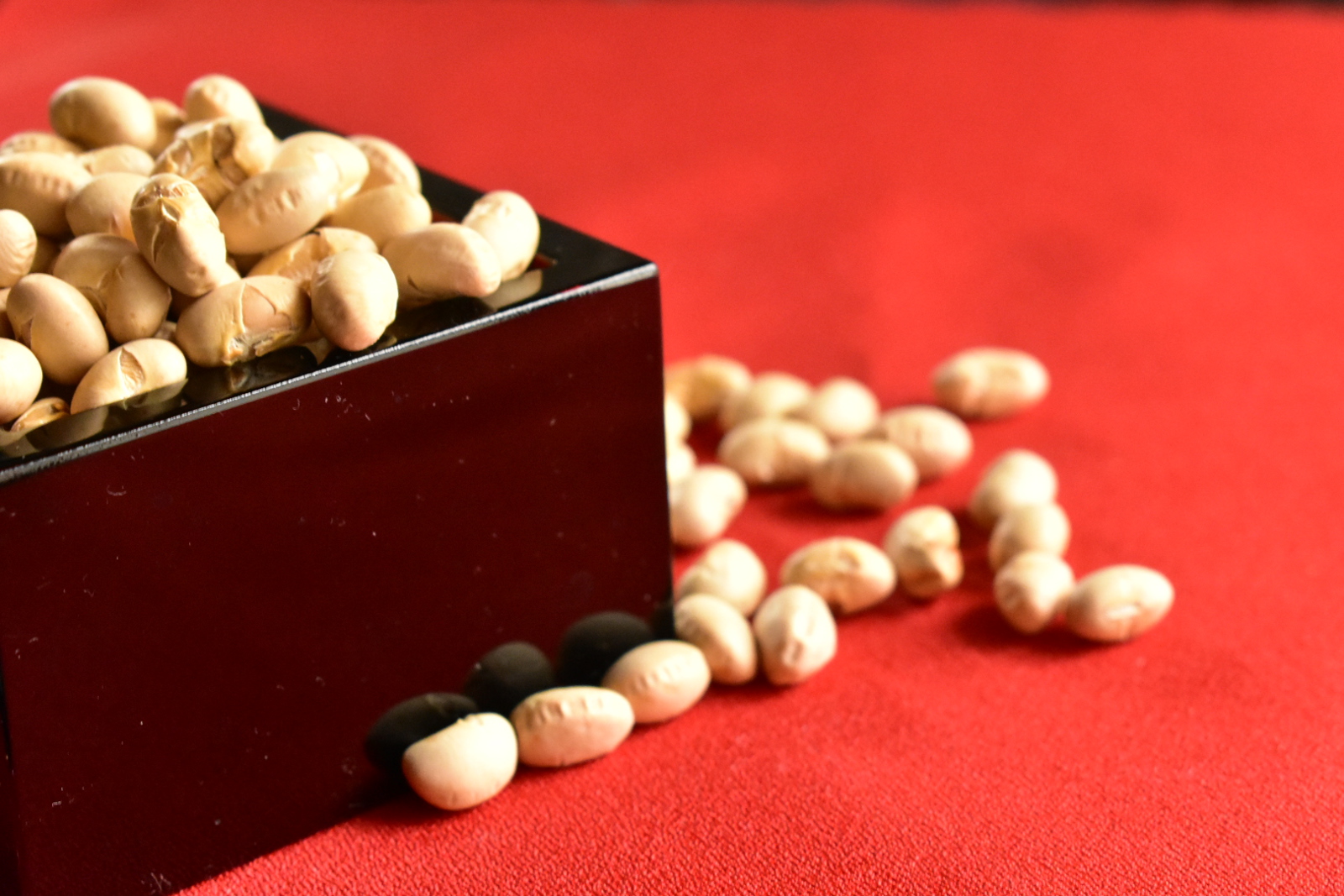
Two customs you can still see in Japan today mark these seasonal boundaries. Setsubun (節分) is the day before Risshun, rather than an additional solar term. Its date can shift; in 2026 and 2027 it falls on February 3.45 That evening, some households scatter roasted beans and call out "Oni wa soto, fuku wa uchi" ("Demons out, good luck in").13 On Tōji, the winter solstice, taking a yuzu bath (ゆず湯, yuzuyu) is a familiar custom, and in some regions people eat kabocha squash. These customs are not observed by every household.14
A small practice for a whole year
Choose one place you can return to: a tree on your usual walk, a pond in the park, the view from a window.
Find today's date in the table and look for the next term. When it begins, write a short note about the light, the temperature and one living thing.
Use the term's name as a question rather than an instruction. If its name mentions dew, look at the grass on a few mornings. If it mentions heat, notice when the day becomes uncomfortable, and whether the evenings bring any relief. Write down what happens, especially when it does not match the name.
Keep the note plain:
The tree is bare. I heard the first bird call earlier. The ground stayed wet all day.
That is more useful than trying to make every entry sound poetic. Over time, the repetition will show you changes you would otherwise forget.
After a season, look back.
Which change came slowly?
Which one appeared between two visits?
Which term's image helped you see something, and which one did not fit?
You do not need to adopt another country's weather.
The small change worth making is to give the passing of your own year a little more attention.
Sources
[01] Metropolitan Museum of Art, Utagawa Hiroshige, Bird on a Plum Branch
[02] National Astronomical Observatory of Japan, 24 Sekki (solar terms) glossary
[03] National Astronomical Observatory of Japan, Koyomi Wiki: What are the 24 sekki? (in Japanese)
[04] National Astronomical Observatory of Japan, 24 sekki and seasonal days, 2026 (in Japanese)
[05] National Astronomical Observatory of Japan, 24 sekki and seasonal days, 2027 (in Japanese)
[06] Kotobank, 啓蟄 (keichitsu): Nihon Daihyakka Zensho and Digital Daijisen (in Japanese)
[07] Kotobank, 芒種 (bōshu): Nihon Daihyakka Zensho and Digital Daijisen (in Japanese)
[08] Kotobank, 白露 (hakuro): Nihon Daihyakka Zensho (in Japanese)
[09] Kotobank, 霜降 (sōkō): Nihon Daihyakka Zensho and Digital Daijisen (in Japanese)
[10] UNESCO, The Twenty-Four Solar Terms (inscribed 2016)
[11] ColBase, Katsushika Hokusai, Picture calendar: Monkey and Beauty (1800), Tokyo National Museum
[12] National Diet Library, History of Calendars in Japan
[13] Kotobank, 節分 (setsubun): Nihon Daihyakka Zensho and Sekai Daihyakka Jiten (in Japanese)
10 Quiet Ways to Bring a Little Japan into Your Everyday Life
Ten quiet invitations to bring Japanese ways of seeing into everyday life.

DISCOVER MORE

CULTURE & SEASONS