“Mum, you’ve already got a sweater like that.”
“But don’t you think this colour is lovely?”
“You’ve already got something almost the same. You don’t need two.”
“Hmm. You’re right.”
A conversation with my daughter in a clothes shop.
Sometimes, even when nothing is really missing from our lives, we find ourselves wanting just a little more.
I already have plenty of clothes. Yet when I see something new, I am tempted to buy it.
It’s not that there’s anything wrong with what I already have.
Still, I can’t help feeling that somewhere out there, there might be something better, something more beautiful, or something more useful.
And strangely enough, getting something new doesn’t necessarily make us feel that we finally have enough.
Once we have one thing, something else catches our attention.
So what exactly is it that we’re missing?
Some links in this guide are affiliate links, which means I may earn a commission if you buy through them.
Knowing What Is Enough — Taru wo Shiru
There is an old Japanese expression, taru wo shiru (足るを知る).
Taru means to have enough, or to be sufficient.
Shiru means to know.
Together, the expression is often translated as “knowing what is enough.”
It is usually explained as being content with what we already have.
Sometimes, it is associated with living simply, owning fewer things, and finding satisfaction in a modest life.
It can even be used to suggest that we should know our place and not expect too much.
I can understand these interpretations.
But recently, I’ve found myself thinking more about one particular word in this expression.
Shiru — to know.
What exactly are we supposed to know?
Does it mean telling ourselves, “This is enough,” even when we don’t quite feel that way?
What Makes a Way of Seeing the World Japanese?
The idea of taru wo shiru is familiar in Japanese life, but it did not originate in Japan.
The ancient Chinese text Tao Te Ching (Laozi) contains the phrase 知足者富 — the idea that those who know what is enough are rich.

Buddhism also teaches the importance of chisoku (知足), or knowing contentment.
Over many centuries, these ideas travelled to Japan, where they were passed down through Buddhist and Zen traditions.
Gradually, they became so deeply woven into everyday life that people no longer needed to think of them as philosophy.
When we speak of a “Japanese way of seeing the world,” we might imagine something that exists only in Japan.
But I wonder if this is actually how many Japanese ways of thinking came to be.
Culture does not develop in isolation, entirely within the borders of one country.
People encounter ideas from elsewhere. They receive them, think about them, and make sense of them through their own experiences and daily lives.
They use them, adapt them, and gradually give them new forms.
And then they pass them on to the next generation.
Over time, something that once arrived as a foreign philosophy becomes a familiar way of understanding the world.
I think taru wo shiru is one of those ideas.
FURTHER READING · AD
Tao Te Ching
Lao Tzu · Translated by D. C. Lau · Penguin Classics
ISBN: 9780140441314
For readers who would like to explore the Chinese text behind this idea more deeply, D. C. Lau’s Penguin Classics translation is a widely respected place to begin.
Where Does the Feeling of “Not Enough” Come From?
In a Buddhist teaching traditionally attributed to the Buddha’s final instructions, we find these words:
不知足者、雖富而貧。
知足之人、雖貧而富。
In English, they mean:
Those who do not know what is enough are poor, even if they are wealthy.
Those who know what is enough are rich, even if they are poor.
Is this simply telling us to be satisfied with what we have?
I think it is asking us something more fundamental.
What does it actually mean to be rich?
We may already have received so much, yet continue to feel that something is missing.
We may have more than enough, yet keep looking towards the next thing we want.
And while our attention is always somewhere else, we gradually lose sight of the richness of what is already here.
We usually think:
“I want more because I don’t have enough.”
But perhaps it works the other way around.
Perhaps it is because we keep wanting more that what we already have begins to seem insufficient.
As long as we are caught up in the feeling of “more” and “not yet enough,” enough will always seem to be somewhere just beyond our reach.
So perhaps taru wo shiru does not mean giving up everything we want.
Nor does it mean forcing ourselves to live with less.
Perhaps it begins with something much simpler.
Pausing for a moment.
Stepping away, just briefly, from that constant feeling of needing more.
Bending Down to See
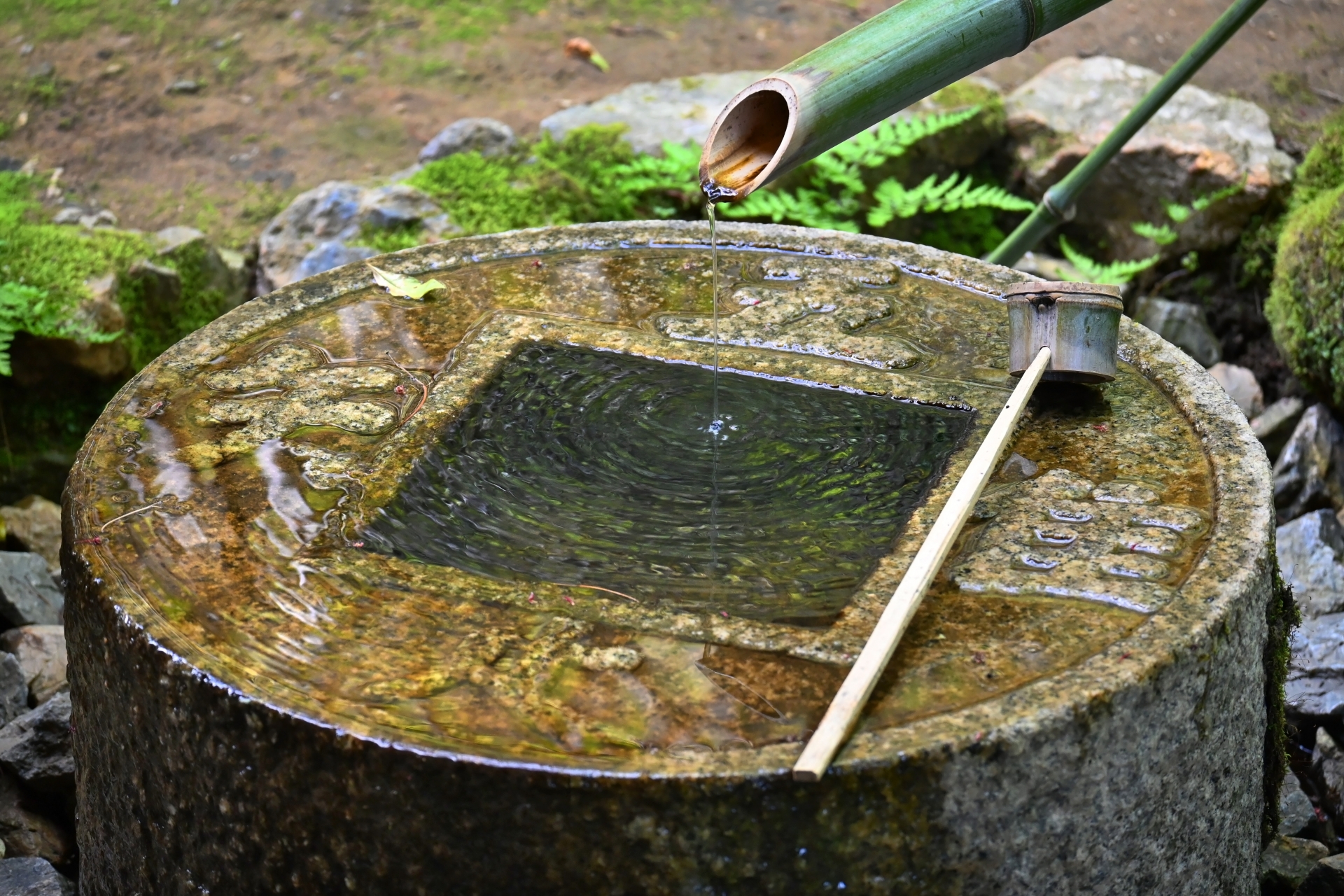
At Ryōan-ji Temple in Kyoto, visitors can see a replica of a famous stone water basin, or tsukubai. The original is kept at the Zōroku-an teahouse and is not normally open to the public.
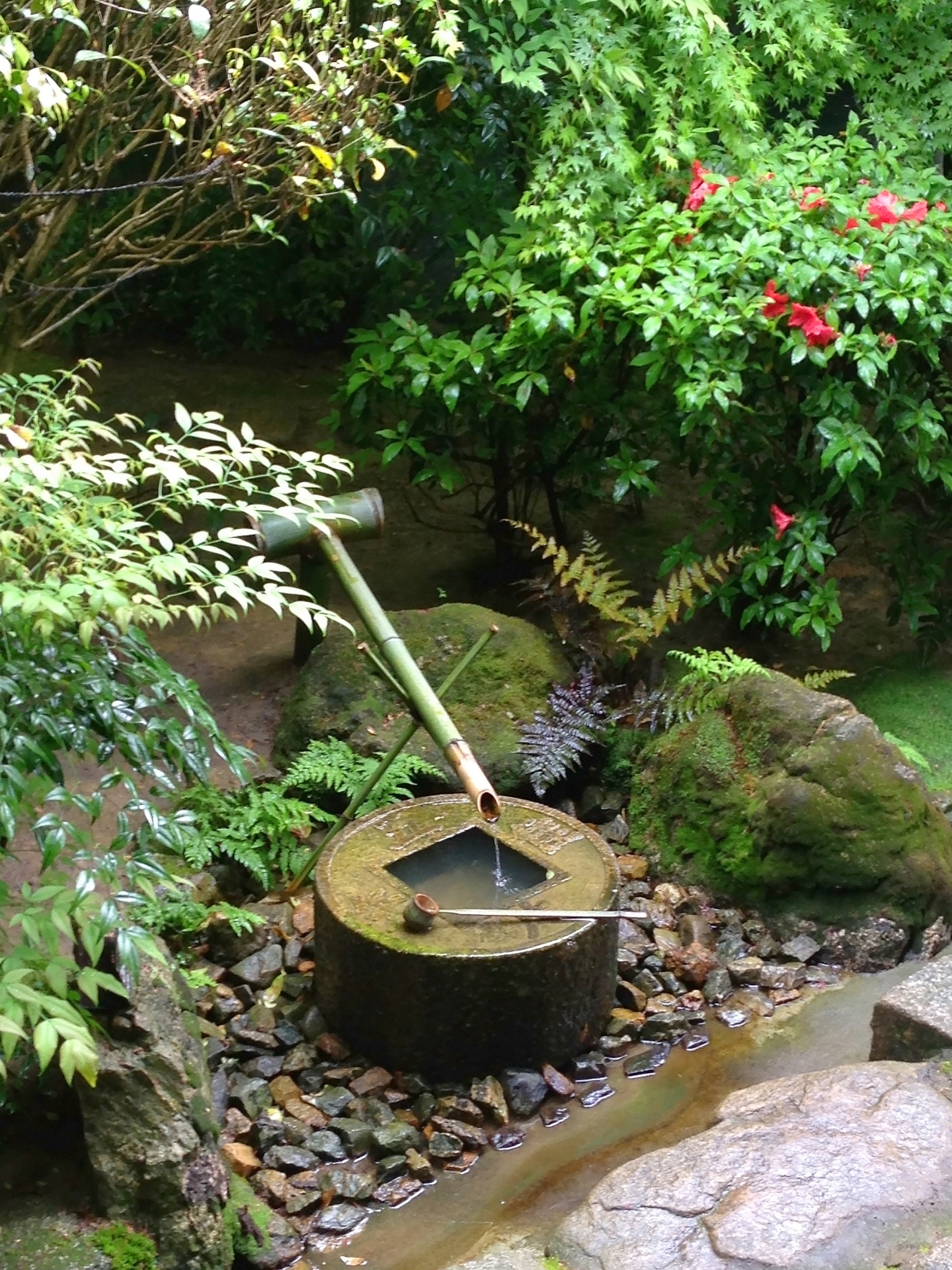
A tsukubai is used to wash one’s hands and rinse one’s mouth before entering a tea room. It is traditionally placed low to the ground, so that anyone using it must bend down.
At the centre of the basin is a square opening that holds water.
The square can also be read as the Japanese character kuchi (口), meaning “mouth.”
When combined with the characters carved around it, it forms the words:
吾唯足知
Ware tada taru wo shiru.
“I simply know what is enough.”
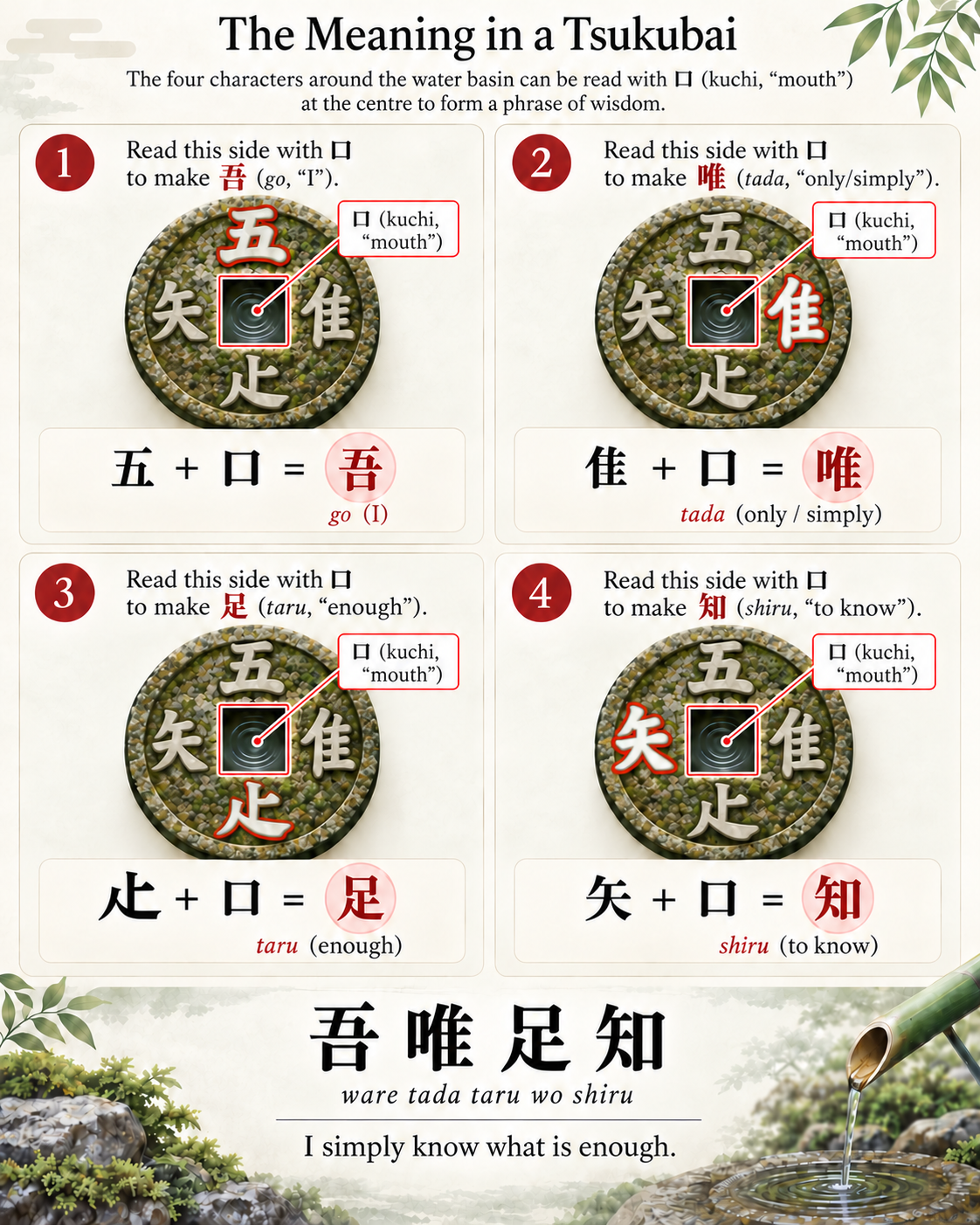
There is something beautiful about encountering these words on a basin that asks us to lower ourselves.
As though we must first bend down and pause before we can truly see what they mean.
And perhaps, in that moment, we might begin to ask ourselves:
What have I already received, here and now?
The お茶碗 (ochawan), the rice bowl that I use every day.
The 湯飲み (yunomi), the teacup someone once gave me.
The autumn light coming through the window.
The table we have gathered around so many times.
Habits that have settled into me over many years.
The people I share meals with.
All these things have been here all along.
Perhaps I simply didn’t notice them while I was looking ahead, searching for something more.
Or perhaps I had begun to see them as ordinary things, hardly worth thinking about.
But when we stop and look more closely, something changes.
Take a single bowl, for example.
someone who made it,
the clay,
the fire,
the people who carried it,
the memory of the day I chose it,
and all the meals I have eaten from it.
Perhaps memories of sharing a table with someone, too.
When I think about all of this, that one bowl suddenly becomes much more than a bowl.
Nothing has been added to it.
It is still exactly the same object.
And yet, somehow, I begin to see more.
The world connected to that small, everyday object seems to grow a little wider.
Back in the clothes shop, when I found myself wanting another sweater much like one I already owned, my attention was on what I wanted next.
On “more.”
But when I pause and think about what I have already received, and all the people and experiences behind those things, I begin to see my life a little differently.
Nothing in my circumstances has changed.
Only the way I see them.
Of course, I don’t mean that not buying something is necessarily the better choice.
I can buy the sweater.
Or I can leave it in the shop.
Perhaps what matters is simply stepping out of the automatic habit of thinking “I need more” and giving myself a moment to pause.
Perhaps knowing what is enough is not about persuading ourselves to live with less.
Perhaps it is what happens when we stop reaching for more long enough to notice how much we have already received.
And suddenly, what seemed ordinary begins to look abundant.
10 Quiet Ways to Bring a Little Japan into Your Everyday Life
Ten quiet invitations to bring Japanese ways of seeing into everyday life.