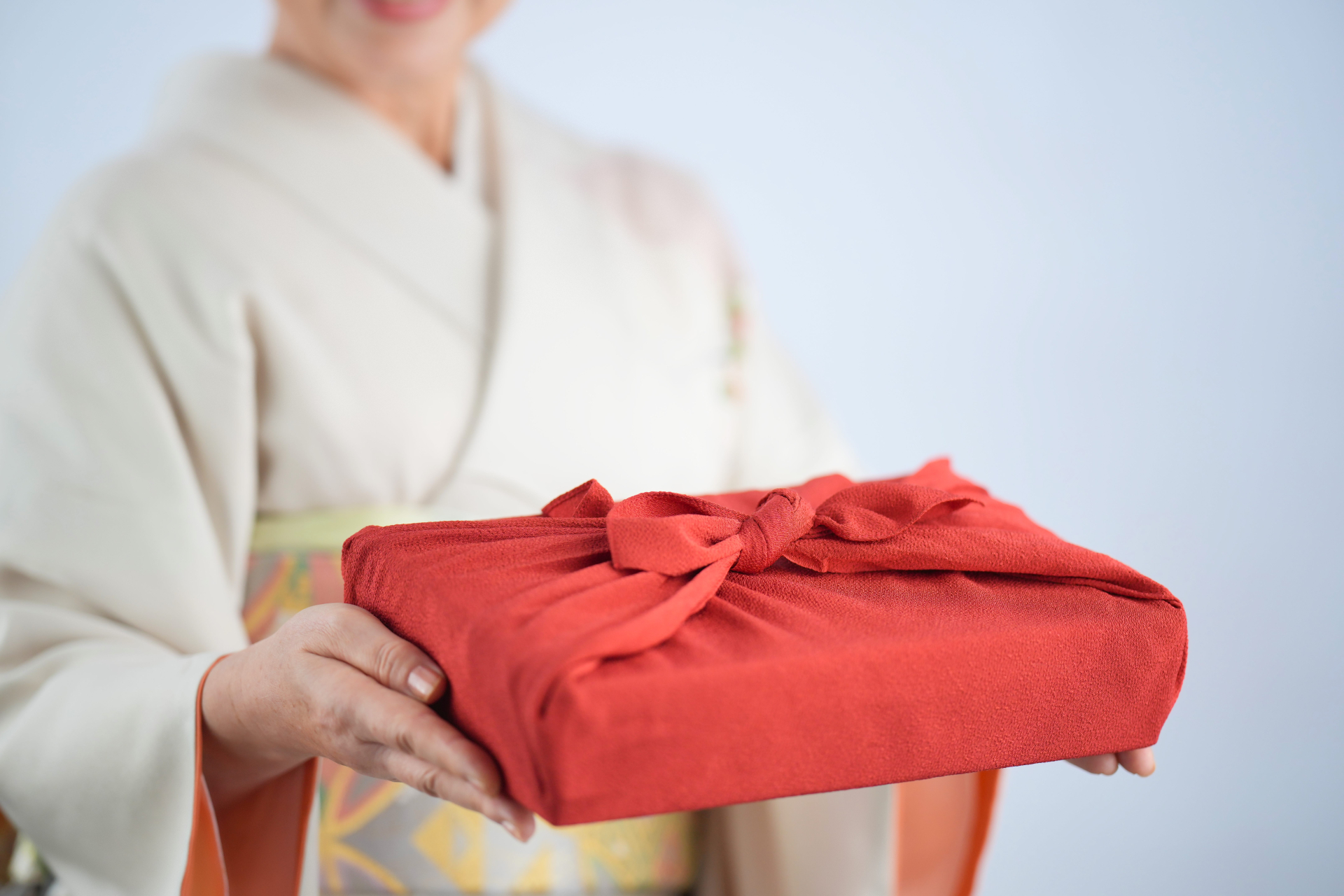
You hand someone a present wrapped in cloth. They admire it, untie the knot, and then pause.
Is the cloth part of the present? Or should they give it back?
That small moment of uncertainty is a good place to start with furoshiki (風呂敷).
The answer depends less on etiquette than on something simpler: a wrapping cloth is made to move from one use to the next. In Japan it has wrapped treasures, kept bathers’ clothes from getting mixed up and folded flat when there was nothing to carry. Before deciding what happens to it after the gift is opened, it helps to know what kind of cloth you are holding.
Some links in this guide are affiliate links. If you buy through them, Japan in Small Ways may earn a commission at no extra cost to you.
Choose for the object you actually have
A furoshiki is a nearly square cloth that has long been used in Japan to wrap and carry things.1
Many are not perfectly square at all. One maker cuts its cloths slightly longer from top to bottom, because fabric tends to stretch more in the other direction over time.2
So the useful question is not whether a cloth is perfectly square, but whether its shape, material and size suit what you want to do.
Start with a box or another light object you already have, and let it decide the size. The table below gives common starting points, but a deep box needs more cloth than a shallow one with the same base.
| Starting size | Possible use | What to test |
|---|---|---|
| 45–50 cm | Small lunch box or compact gift | Enough fabric for the object’s depth and the knot |
| 68–70 cm | Medium gift or a wine bottle | Material, bottle size and the wrap you choose |
| 90–120 cm | Larger bundles, or for use as a bag | A secure knot and comfortable handling |
| Any suitable square cloth you own | Practice, or a light gift | Condition, size, slipping and whether the dye may run |
Sizes based on one furoshiki maker’s guide2, which lists cloths from about 130 cm for uses such as covers and tapestries.
If you can, test before you buy. Lay the cloth diagonally under the object and bring the corners up. Do they cover it, with enough length left for the knot? Does the fabric gather neatly, or does it make the knot awkward?
A square scarf or cloth you already own is fine for learning the movements. It does not need to be sold as Japanese. Just check its condition, and do not expect a delicate accessory to carry something heavy.

Fabric changes the experience
If you plan to use and wash your cloth often, cotton is a practical choice.
Different fabrics need different care. Cotton and polyester can usually be washed by machine or by hand, but wash them separately, because the color may transfer. Silk and rayon are often dry-clean only, because they may shrink when wet. Silk can also turn yellow in sunlight, so store it somewhere dark.3 Always read the care label on your own cloth.
Once the practical choices are made, the pattern starts to do something interesting. A reversible cloth shows its second color in the knot. A large picture may almost disappear once the parcel hides its center.
There is no need to see modern patterns as less “authentic”. A new design can make an old way of wrapping easier to enjoy in your own life.

One simple wrap is enough to begin
Japan’s Ministry of the Environment has published an illustrated guide showing fourteen ways to use a furoshiki, from a basic carry wrap to two different ways of wrapping a bottle.4
The first, the basic carry wrap (お使い包み, otsukai tsutsumi), suits a light box well. The guide’s illustrations show roughly this sequence:
Lay the cloth like a diamond, with the box in the center.
Fold the corner nearest you over the box.
Fold the opposite corner over it.
Bring the two side corners up and tie them together on top.4
Otsukai tsutsumi · the basic box wrap


Original Japan in Small Ways illustration. Practice with an empty box.
Tie the corners with a square knot, also called a reef knot (真結び, ma-musubi), which lies flat and holds well when tied correctly. A common way to remember it is “right over left, then left over right”.
Ma-musubi · square knot


Original Japan in Small Ways illustration. B and D identify the same two cloth ends throughout.
Practice with an empty box first. If the ends are too short or the cloth slips, try a larger cloth or a different wrap, and support anything fragile from underneath.
A few unhurried attempts will teach you more than buying several sizes before you have tried one.
Say what happens to the cloth
If the cloth is part of the gift, say so: “The wrap is yours too. I thought you might enjoy using it again.”
If it is your own cloth for carrying, unwrap the gift as you hand it over, or explain that you are keeping the wrap. That way, the other person does not have to guess.
In my own gift-giving, I choose a more decorative cloth and wrapping style when the cloth is part of the present. When I intend to keep it, I use a simpler wrap, often in a darker color, and unwrap the gift before handing it over.
In Japan, too, expectations differ between formal and casual situations. For a beginner overseas, being clear is more useful than any rule that says Japanese etiquette “always” means returning the cloth – or always means keeping it.

But why wrap a gift in cloth at all? The habit is far older than the word furoshiki.
The idea of keeping things clean
The custom of wrapping valuable objects in cloth is said to go back to the Nara period (710–794).1 Writings from that time mention tsutsumi, cloths used to wrap the treasures kept in the Shōsōin, the imperial storehouse at Tōdai-ji temple.5
Wrapping made things easier to carry, but it is thought to have had a religious meaning too: keeping a precious object clean and pure. Some say a trace of that idea remains whenever a gift is wrapped in furoshiki today.6

How the bath got into the name
The name itself came much later. “Furo” (風呂) means bath, and “shiki” (敷) means to spread out.16
In the Edo period, communal bathhouses became popular in the cities. People bundled their clothes in wrapping cloths in the dressing room, so that their belongings would not get mixed up with other bathers’. Later, all wrapping cloths came to be called furoshiki.16

You may also hear a more colorful story. The story goes that in the Muromachi period the shogun Ashikaga Yoshimitsu (足利義満) built a large bathhouse to entertain feudal lords. They wrapped their clothes in cloths marked with their family crests, and after bathing spread them out to stand on while they dressed.5
It is a lovely story, and it fits the “spread” in the name. Enjoy it as a story, rather than as proof that one famous bathhouse invented the furoshiki.
Whatever the origin of the name, the cloth’s appeal was easy to see: it folded flat when empty and changed shape for whatever it carried. Travelers in Edo-period woodblock prints often carry bulging furoshiki on their backs.1
Out of daily life, and back again
From the late nineteenth century, as Japanese lifestyles became more Western, furoshiki began to fall out of use. After the Second World War they largely disappeared from everyday life, replaced by handbags, backpacks and disposable shopping bags.1
More recently, furoshiki have come back as an alternative to disposable bags. In 2006, Environment Minister Koike Yuriko devised the “Mottainai Furoshiki” to help cut plastic bag waste. Mottainai means, roughly, “what a waste”. The cloth carried designs by the Edo-period painter Itō Jakuchū (伊藤若冲) and was made from recycled plastic bottles.9
A cloth made from recycled bottles and printed with an Edo painting is a good picture of what a revival is: an old form, with new materials and new reasons to use it.

A Japanese history within a wider world of cloth
Japan’s textile history includes skills that came from outside. In the Yayoi period, for example, people began making silk using techniques introduced from mainland China and the Korean peninsula.6
Wrapping things in cloth is found in other places too. Korean wrapping cloths, bojagi (보자기), are one example.10
This does not mean that furoshiki came directly from bojagi. Similar needs can lead to similar practices, without any documented link between them.
That wider view makes the furoshiki easier to understand. Its Japanese history lies in its name, its uses and how it is made, not in owning the idea of putting cloth around something.
Make reuse something you do
A cloth becomes “reusable” only when it is actually used again.
A drawer of beautiful cloths, each used once, is not so different from a drawer of gift bags.
Choose one cloth you can look after, then give it its next job. It might hold a lunch box, carry a light bundle or wrap another gift. How much this helps the environment depends on the material and on how often you actually use it.
The small thing worth bringing into everyday life is the habit of letting one object serve many occasions. You can learn the knot quickly. The more lasting pleasure is finding out what your cloth will do next.
Sources
[02] MUSUBI (Yamada Seni), FAQ: sizes and shape
[03] MUSUBI (Yamada Seni), Care Instructions
[04] Ministry of the Environment, How to Use Furoshiki (illustrated guide)
[05] Embassy of Japan in Singapore, Japan Creative Centre, Furoshiki Guidelines (2010)
[07] Metropolitan Museum of Art, Souvenirs Covered with Wrapping Cloth (probably 1816)
[09] Ministry of the Environment, Mottainai Furoshiki (2006, in Japanese)
[10] Metropolitan Museum of Art, Bojagi (wrapping cloth), Korea
10 Quiet Ways to Bring a Little Japan into Your Everyday Life
Ten quiet invitations to bring Japanese ways of seeing into everyday life.

DISCOVER MORE

CULTURE & SEASONS