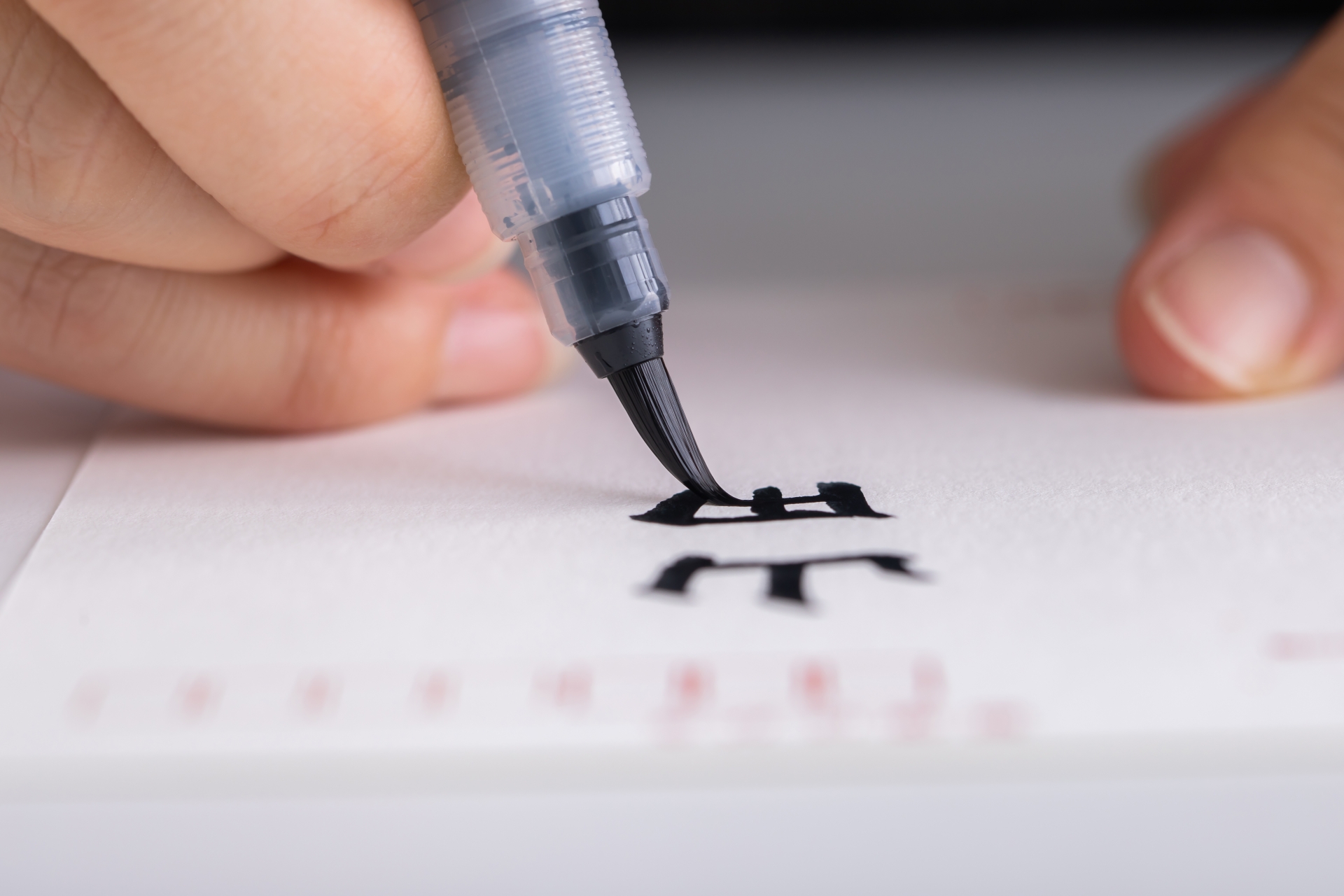
A brush pen can make a simple line feel surprisingly unfamiliar. Press a little more, and the line widens. Lift your hand, and it narrows again. With a soft bristle tip, even a small hesitation can leave a mark.
That responsiveness is part of the pleasure. But choosing a brush pen can be confusing, because the same name is used for different kinds of tips.
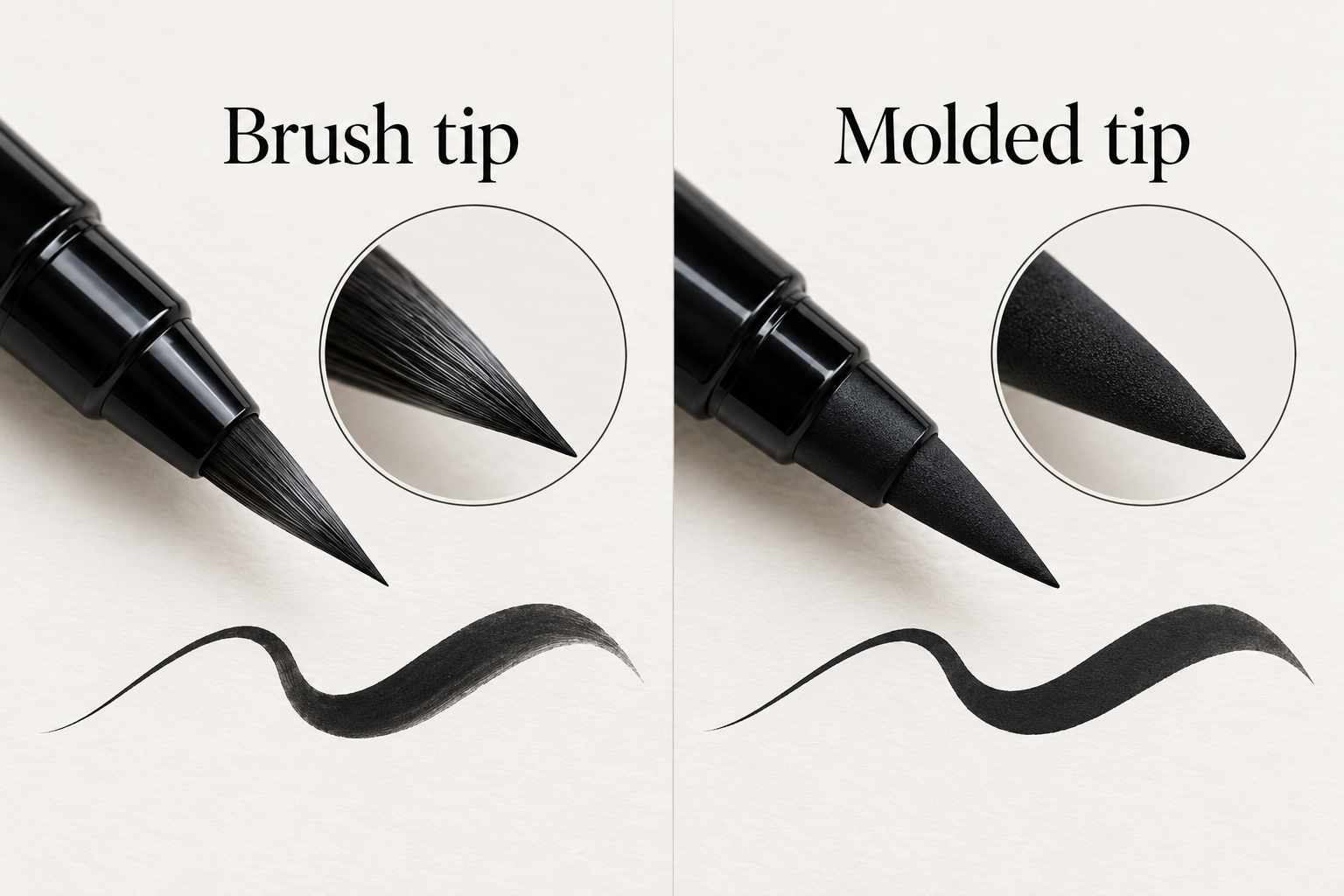
In an English-language art shop, a brush pen might have a flexible, shaped tip designed for lettering. A bristle-tip fudepen (筆ペン), on the other hand, has a bundle of fine fibers that move more like the hairs of a traditional Japanese brush.
Both kinds are made and used in Japan, and both can be found abroad. The important difference is not Japanese versus Western. It is how the tip is made, and how it responds to your hand.
This guide begins with the bristle-tip kind, using a familiar Japanese pen as an example.
Some links in this guide are affiliate links. If you buy through them, Japan in Small Ways may earn a commission at no extra cost to you.
As an Amazon Associate I earn from qualifying purchases.
Two tools that share one name
A molded-tip brush pen has a flexible point made as one piece. Tombow’s Fudenosuke, for example, uses elastomer, a rubber-like material. The tip bends under pressure and springs back, making changes in line width relatively easy to control.01
A bristle-tip pen works differently. Its point is made from many separate fibers. As you press, the fibers spread slightly. As you lift, they gather again towards a point. The feeling is closer to using a brush whose hairs carry ink.
Neither type is inherently better. A molded tip may feel easier for small, controlled lettering. A bristle tip allows you to explore the movement of a traditional brush.
Before choosing a pen, look closely at its tip rather than relying on the words “brush pen” on the packaging.
A standard to start with: the Pentel Fude Brush Pen
For a first bristle-tip pen, I recommend the Pentel Fude Brush Pen in medium (XFL2L).
Pentel launched its nylon-bristle brush pen, Pentel Fude, in 1976, and it is still sold under that name.0203 Pentel describes the tip as made of high-quality nylon bristles, each one finely processed, and the pen takes a replaceable ink cartridge (XFR-AD).03
The range comes in extra-fine, medium and bold, and in two alternative tips: one packed more tightly for a firmer point, and one thinned for a softer one.03 That variety is a reminder that “brush pen” never means one single feel.
The ink is supplied from inside the pen, so you can experience something of the movement of an inked brush without preparing an inkstone. The medium tip is versatile enough for writing a name or a short message, while allowing you to see how the fibers open and gather as your hand moves.
Using a bristle tip: let the brush do the work
A bristle pen will not feel easy at first. The line may wobble, or swell where you didn’t mean it to. That is not a fault in the pen or in you. It is the brush responding.
Hold the pen a little more upright than you would an ordinary pen, and keep your grip light. Start with almost no pressure, so only the very point touches the paper. Then press gently and watch the tip open. Lift slowly and watch it gather back to a point.
For now, that is enough. Simply getting to know how the tip opens and gathers is a good first step.
The way a stroke begins and ends is what gives Japanese brush writing its life, and it takes more than a practice sheet to learn. We will look at how to write with a brush pen in a separate guide.
Choose the ink and the paper together
Once your lines begin to look like brush strokes, you may want to add color over them. That is when the ink matters. Check the ink details rather than assuming every black brush pen is waterproof. Makers distinguish dye inks from pigment inks, and each formula is different. A water-based ink can still contain pigment: “water-based” is not the same as “water-resistant”.
Pentel lists the ink in the Fude Brush Pen as water-based dye.03 Dye inks generally run when they get wet again, so test before painting over your lines.
If you want to paint a watercolor wash over your lines, look at a pigment-ink bristle pen instead. Pentel UK describes its Pocket Brush as having synthetic bristles and a pigment ink that is water- and fade-resistant. It takes FP10 cartridges.04 Pentel Japan lists the ink of its own pocket brush pen as water-based pigment.05
(Molded-tip pens can use pigment ink too: Tombow describes the ink in its black Fudenosuke pens as a water-resistant, light-resistant, water-based pigment ink.01)
Even a maker’s “water-resistant” label shouldn’t replace a test. Try it on the paper you’ll actually use, and let the ink dry fully first.
FURTHER READING · AD
Pentel Arts Pocket Brush Pen
Pentel
With two refills · GFKP3BPA
Paper can change your experience as much as the tip. On one sheet the line may stay crisp; on another, it may spread or show through.
For small brush-pen writing, start with a smooth, ordinary sheet of paper. There is no need to buy special paper before you begin.
When a molded tip is useful
If you would prefer a firmer, more predictable point, Tombow’s Fudenosuke is worth comparing. It is particularly useful for small lettering and for learning how pressure changes the width of a stroke.
The Fudenosuke set recommended here includes soft, hard and twin-tip pens. These offer different degrees of control, but they do not have the separate bristles of the Pentel Fude Brush Pen.
FURTHER READING · AD
Tombow Fudenosuke Brush Pens
Tombow
Soft, Hard and Twin Tip — 3-pack
| What you want to try | A useful starting point | What to check |
|---|---|---|
| The opening and gathering of a brush | Bristle-tip fudepen | How the tip is made, and whether refill cartridges are available |
| Brush lines under a watercolor wash | Bristle-tip pen with pigment ink | The maker’s water-resistance claim, then your own test |
| Names, cards or alphabet lettering at a small size | Fine, fairly firm molded or fiber tip | A writing sample at the size you plan to write |
Why a brush became a pen
The fudepen, literally “brush pen”, is a modern writing tool rather than an object handed down unchanged from the past. A Japanese dictionary defines it as a pen designed to give the feel of a brush, with ink stored inside and fed to the tip.06
Several Japanese makers developed brush pens in the 1970s. One encyclopedia dates the brush pen’s development in Japan to 1971.06 Kuretake, a Nara company founded as an ink-stick maker, says it developed its brush pen in 1973 by combining its ink-making know-how with the marker-pen technology it had built up.07 Pentel’s nylon-bristle pen, the one this guide starts with, followed in 1976.02
The appeal was practical. As Kuretake tells it, there were still many moments in daily life when brush writing was preferred (New Year’s cards, for example), and a pen that made brush lettering easier would help people who were not confident with a brush and ink.08 Today, Kuretake says, the brush pen has settled into everyday life and has become essential for weddings, funerals and other ceremonial occasions.07
The modern tool did not erase the customs attached to the writing. Condolence envelopes, for instance, are traditionally written in pale ink, usuzumi (薄墨).09 Kuretake sells a pale-ink brush pen made especially for these envelopes.10
So in that setting, gray ink is not simply a softer color choice. In your own sketchbook, of course, you can choose gray because you like it; if you are writing for a Japanese ceremony, check the custom for the occasion.
This is a modest example of cultural adaptation. A new mechanism can support an older practice without reproducing all of it. Using a brush pen doesn’t make you a calligrapher, and it doesn’t need to. It can simply bring a different kind of movement into something you already do.
Try one pen before building a collection
Start with one black bristle pen and a few suitable sheets. Draw a light line, then one with a little more pressure. Try a slow curve. Notice when the tip feels steady, and when it feels as if it is leading your hand.
Next, repeat the same marks on a second paper. This is a good way to separate the feel of the pen from the behavior of the surface.
Put the cap back on promptly. Don’t scrub the point against the paper to force more ink out. Before you rely on a cartridge pen, check that the exact refill is available where you live. The cartridge codes above (XFR-AD for the Fude Brush Pen, FP10 for the Pocket Brush) make the right refill easier to find.
You may one day want a separate brush, an inkstone and larger sheets. You may also find that writing one name carefully on an ordinary card is enough. Both begin with the same small act: paying attention to the line your hand is making.
Sources
[01] Tombow, Fudenosuke
[02] Pentel, Company History 沿革 (in Japanese)
[03] Pentel, ぺんてる筆 (Pentel Fude Brush Pen) (in Japanese)
[04] Pentel UK, Brush Pen XGFKP (Pocket Brush)
[05] Pentel, ぺんてる筆〈携帯用〉 (Pocket Brush) (in Japanese)
[06] Kotobank, Fudepen 筆ペン (in Japanese)
[07] Kuretake, KURETAKE Brand History (in Japanese)
[08] Kuretake, Inktober History & Techniques
[09] Kotobank, Kōden 香典 (condolence gift) (in Japanese)
[10] Kuretake Official Online Shop, のし袋用筆ぺん うす墨 DBD161-82S (in Japanese)
[11] The Metropolitan Museum of Art, Kubo Shunman, Table and Writing Set
10 Quiet Ways to Bring a Little Japan into Your Everyday Life
Ten quiet invitations to bring Japanese ways of seeing into everyday life.